Hannes Bosch—Theo Bosch
The CallerThe relationship between Hannes Bosch and Theo Bosch turns a father’s carefully considered permission into a source of devastating guilt. Hannes tries to make Theo’s solo hike safe through planning, equipment, and check-ins, but those precautions cannot protect his eight-year-old son from the dogs that kill him. In the aftermath, Hannes cannot separate his encouragement from the loss.
A shared wilderness ideal
Theo’s wish to hike grows from his absorption in television footage of Lars Monsen travelling through the wilderness. Watching him paddle, fish, make camp, and sleep outdoors, Theo imagines himself as an explorer; the forest is not merely a destination but a life he longs to try on. His enthusiasm is vivid enough that he runs to find his mother after watching two episodes, only to find her resting with a headache.
Hannes enters the bedroom and shares a private, joking moment with Theo. When Theo asks if he can go to Snellevann alone, his father does not dismiss the request as childish. He recognizes the intensity behind it: Theo wants to hear the forest, see its birds and fish, and become the explorer he has been imagining. Hannes’s attention to that desire is part of their closeness, but it also puts him in the position of deciding how far a small boy may be allowed to follow it.
Permission, caution, and preparation
Hannes weighs the practicalities rather than agreeing immediately. He calculates that the walk to Snellevann will take about an hour, with another twenty minutes at the water and the return journey: two hours and twenty minutes in all. Theo is only eight. Still, it is early, the weather is fine, nightfall is distant, and people working in fields or out walking and cycling may be on the route. Most important to Hannes, the family had already agreed that the woods were safer than almost anywhere else.
His decision also involves a quiet departure from Wilma Bosch’s likely response. Hannes expects Theo’s mother would say no, and Theo proposes that they not ask her. Father and son tiptoe out together. The scene makes their cooperation affectionate but consequential: Hannes does not simply grant a request in the open; he helps Theo go despite anticipating a disagreement at home.
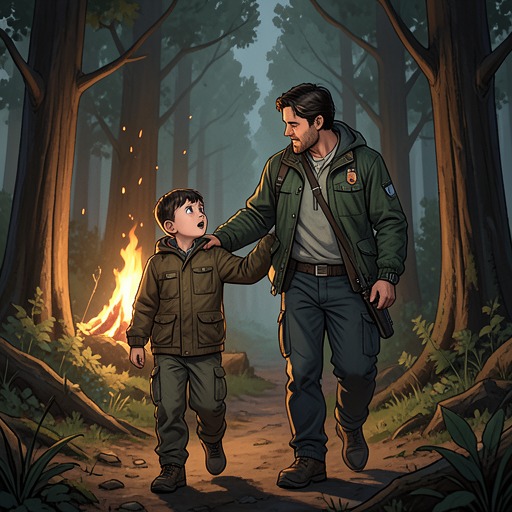
Once committed, Hannes gives the outing the structure of an expedition. He tells Theo to plan as Lars Monsen would, attending to food, equipment, and clothing. He warns him not to wear sandals, has him fetch a belt for a knife, and jokes about needing it in case of Indians. Theo puts on trainers, double-knots the laces, and is visibly excited. The details show Hannes trying to translate his son’s fantasy of wilderness travel into practical readiness, while also treating him as brave and capable.
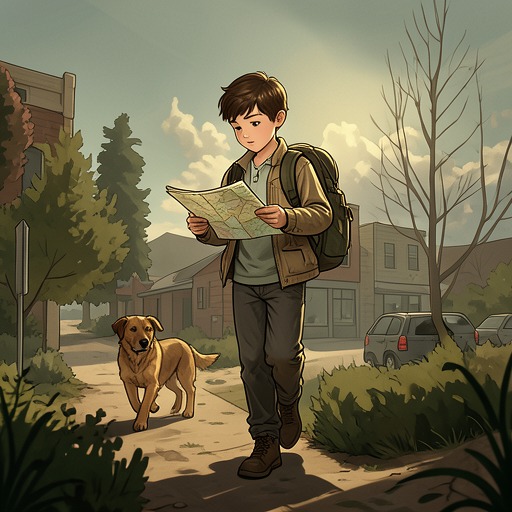
Hannes does not send Theo off from the doorstep. He walks with him for fifteen minutes along the main road to the metal barrier near Glenna, where they stop and speak before Theo continues alone. Later, Hannes phones him and keeps Wilma beside him so she can hear. He asks how far Theo has gone, whether he has met anyone or seen animals, whether he is cold, and whether he is climbing toward the hills near Myra. When Theo is past Granfoss, Hannes tells him to put on his jumper if the weather turns cloudy. Their contact is practical and attentive, an effort to remain involved even after the separation at the barrier.
The search and the irreversible change
The call cannot settle the parents’ unease. Hannes and Wilma eventually go looking for Theo, and Hannes explains to Konrad Sejer that they have tried to reach their son without getting an answer. He says they came to be on the safe side; then he sees the green tarpaulin and realizes that something has happened. His arrival at the scene transforms the earlier act of escorting Theo to the barrier into the beginning of a search for him.
When Wilma is told that several dogs, perhaps a whole pack, attacked and killed Theo, she is taken to the Central Hospital for treatment for shock. The loss is not an abstract consequence of a risky outing: the boy whom Hannes expected to walk to the water and return home is gone. The contrast between the father’s detailed estimate of the trip and its actual ending gives his earlier confidence a terrible weight, without making his precautions a guarantee they could ever have been.
Guilt after Theo’s death
Hannes’s grief fastens on responsibility. He repeatedly thinks that Theo’s death is his fault and calls himself a coward. When Sejer and Jacob Skarre visit, Hannes is sitting with Theo’s Optimus Prime toy on his lap, trying and failing to change the robot into a truck as Theo used to do. The familiar toy remains present, but the simple sequence of movements his son knew how to perform is beyond him.
The house’s small sounds become bound up with the absence. Hannes hears clicking in the hallway and imagines that Theo has returned, perhaps after meeting his grandfather Pim on the other side, because Wilma needs him and small boys should stay on Earth. Each time, no Theo comes quietly into the room. His hope is momentary, and its repetition measures how difficult it is for him to accept the permanence of the loss.
Hannes also cannot bear to go to the hospital while Wilma is screaming after being told what happened; he says she would not see him anyway. When Sejer asks him to help compile a list of local dog owners, Hannes is still caught between private collapse and the investigation. His relationship with Theo therefore ends in two linked forms of helplessness: the father who had planned the hike cannot undo its outcome, and the father who now blames himself must nevertheless face the work of finding the dogs responsible.